The National Institute for Health and Care Research (NIHR) BioResource has partnered with a health equality community organisation in Manchester with the shared goal of improving Black health outcomes by including more Black people in health research.
BHA for Equality in Manchester were awarded a strategic funding grant from the NIHR North West Regional Research Delivery Network (RRDN) to work alongside the Improving Black Health Outcomes (IBHO) BioResource through to March 2026. IBHO invites people to take part in research that looks at different health problems and how they affect Black communities.
The IBHO BioResource has recently celebrated its first birthday, having launched in July 2024. It is a group of over 5,000 volunteers from Black communities, with and without health conditions, who are happy to take part in research. People with Sickle Cell or Thalassaemia can also join the study, even if they are not from Black communities. This includes children under 16.
BHA for Equality
BHA for Equality has a 35-year history of working with Black, Asian and other minority communities on health conditions that are found in those communities. They have previously worked with the NHS to improve health education and promotion programmes on Sickle Cell and Thalassaemia, HIV and sexually transmitted infections (STI), Hepatitis C, tuberculosis and prostate cancer. They also worked on the delivery of the UK’s first pilot of lung health checks which received national and international recognition for its success.
In addition to other previous leadership roles in the Manchester area, BHA currently serve as chair of the African & Caribbean Sounding Board, a consultative and advocacy body working to ensure that the lived experiences and needs of African and Caribbean residents are central to local health policy and service design.
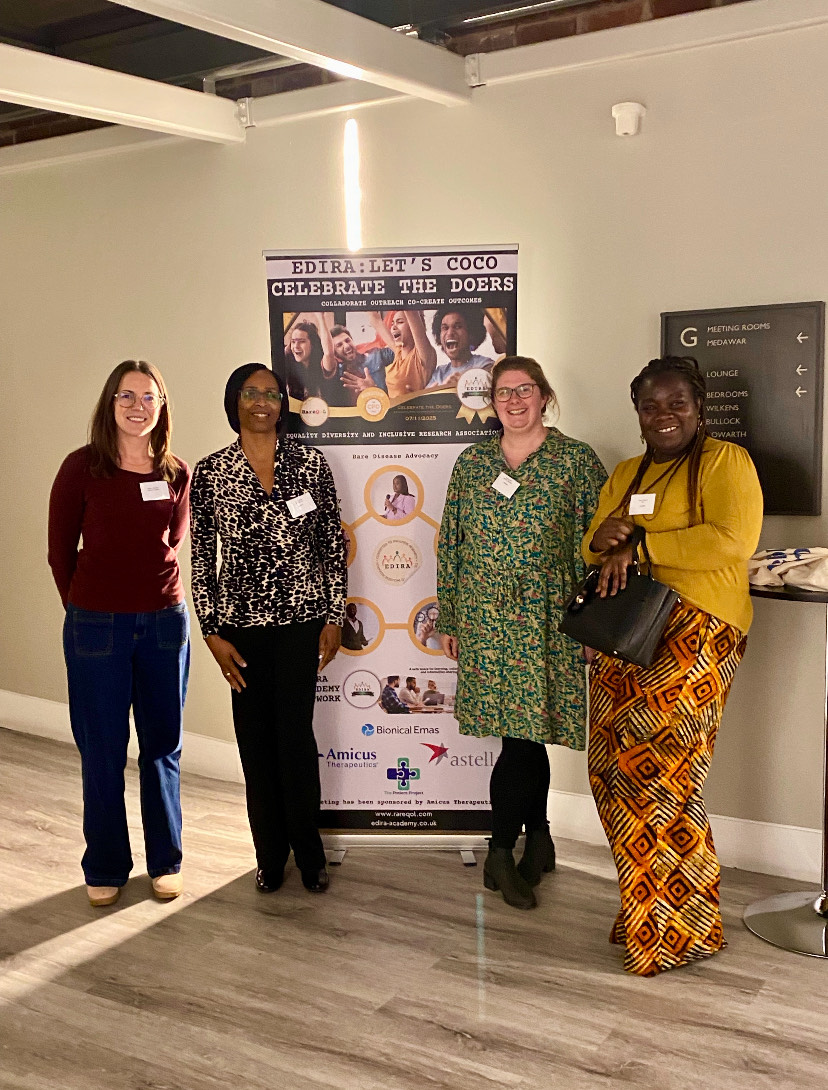
From left to right: NIHR BioResource Senior Coordinator for PPIE, Shayna Rodriguez; BHA's Director of Policy, Engagement & Development Donna Miller; the BioResource's Director of Operations Hannah Stark; and BHA's Community Engagement and Development Lead Sandra Oppong attended the Equity, Diversity and Inclusion Research Alliance (EDIRA) conference on 7th November, 2025 to present their work.
Donna Miller, BHA for Equality Director of Policy, Engagement, & Development said:
“We are thrilled to work with the BioResource on their mission to make sure people from Black communities are represented in health research. Combining our close ties with our communities and the BioResource’s many years of facilitating ethically sound health research, we hope to make strides toward addressing this long overdue issue.”
Professor Nathalie Kingston, NIHR BioResource Director, said:
“It is critical that we work alongside trusted community partners as we connect with Black communities. Given BHA’s experience and broad network in the Manchester area, this collaboration is essential to ensure that the IBHO BioResource can successfully shed more light on the health challenges that particularly impact Black communities."
With extensive experience in community engagement, BHA has to date attended and hosted 35 events and activities in community centres, mosques, churches and shopping centres to spread the word about IBHO. They will also use mobile units and work with employers and voluntary units to raise awareness and answer any questions about the programme.
“We have already seen that standing shoulder-to-shoulder with BHA at events in the community events is helping people to feel more comfortable to approach us and talk about taking part in health research,” said Laura Crowther, Clinical Trials Manager at the Manchester Centre for Genomic Medicine.
Historically, due to past discrimination and current implicit biases (negative attitudes, of which one is not consciously aware, against a specific social group), there has been an under-recruitment of Black people in health research. This means that much of what we know about many health conditions is usually based on white populations.
Representation is crucial, as research findings may not always be applicable to groups outside of those included in studies, meaning that the development of new assessment tools, treatments and services might not necessarily benefit everyone. The IBHO BioResource aims to address this gap and improve Black health outcomes by including more Black people in health research – a vision that aligns with the BioResource's overall goal to ensure the resource is representative of the UK population.
The NIHR funds, enables and delivers world-leading health and social care research that improves people's health and wellbeing and promotes economic growth.
By volunteering to take part in research, you’re learning more about your health and improving future treatments for the nation.
For more information about this study and to register your interest, please visit the Improving Black Health Outcomes (IBHO) BioResource website.